Heritage
Click on each tab/title
- Swansea Canal
- Ynysmeudwy Pottery
- All Saints Church Rose Window
- Llangiwg Church
- Cambrian Records
- Dai 'Tenor'
- Neolithic Stone Axe
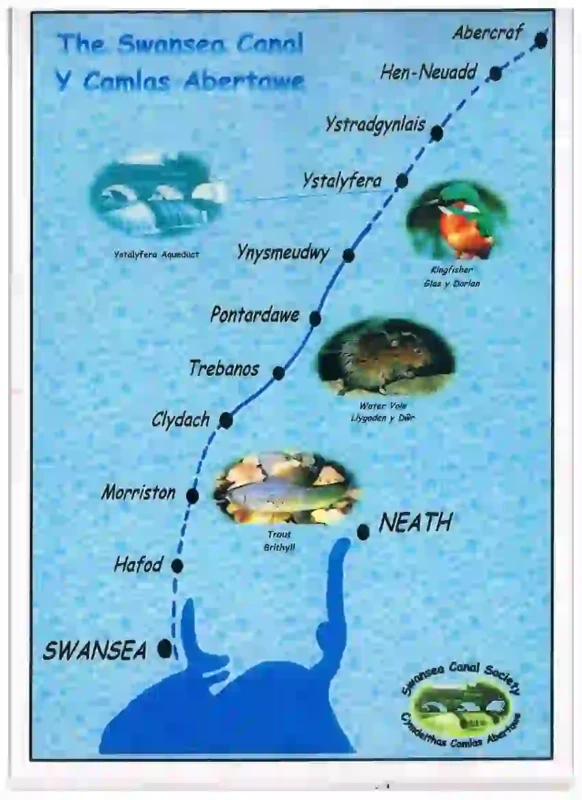
The Swansea Canal was constructed by the Swansea Canal Company during the years 1794 – 1798. The first section of the canal running from Swansea to Godre’r Graig was opened for navigation in 1796.
When completed the canal was 16 miles long, had 36 locks and 5 aqueducts.
With the opening of the Swansea Valley Railway in 1859 the canal lost much of its commercial trade and in 1873 the Swansea Canal Company sold the canal to the Great Western Railway. The canal continued to carry commercial traffic until 1931.
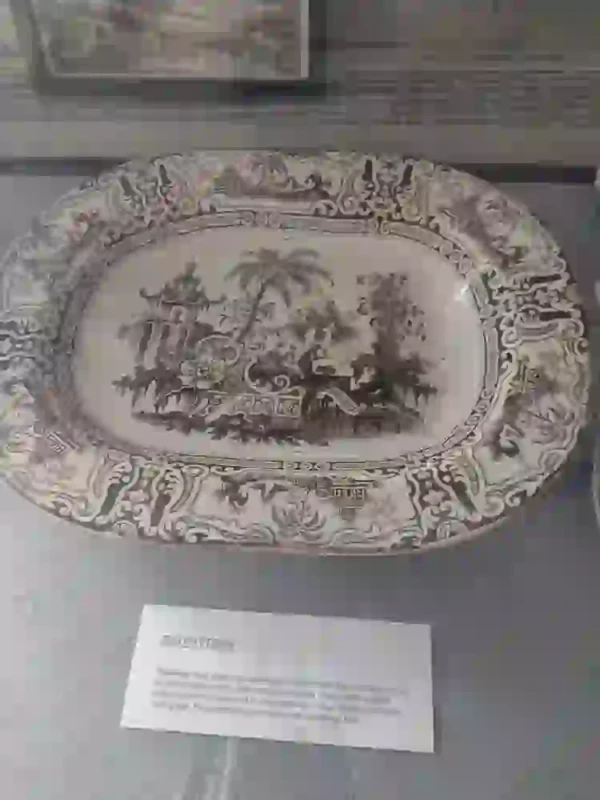
The works at Ynysmeudwy, on the bank of the Swansea Canal (at Ynysmeudwy Uchaf farm) and some 10 miles north of Swansea and approximately 1 mile from Pontardawe, was originally opened in 1838 on the site of a former grist mill by Michael Williams Snr (1792-1841) to produce firebricks for use in the Morfa Copper Works, Landore, where he was manager. His intention was for youngest son William (1824-1880) to manage it. Ebenezer Edwards, a local builder, was engaged to construct the works. The 99 year lease was signed on 24th June 1841 (it being common in those days to give a period of grace for construction etc).
But, Michael died on 21st December 1841 and eldest son Michael Martyn Williams who inherited his estate took over the running of the works as William, aged just 17, was still a minor. Michael Martyn took out a lease with the Earl of Jersey to extract clay from the Llysnewydd Marsh (now site of the Liberty Stadium) and the works at Ynysmeudwy was named the Llysnewydd Brickworks. In March 1845 William became of age and, with £500 left to him in his father’s will, began to produce earthenwares on the same site but as a separate enterprise named the Ynysmeudwy Pottery, the two concerns operating side by side, William simply adding a few extra buildings and kilns. It was he who constructed Ynysmeudwy House as his private residence. The house later became the Glanafon Country Hotel but was destroyed by fire in 1991 and was eventually demolished.
In 1856, Michael Martyn Williams left for Gloucester. William, another brother Charles and a local businessman, William Henry Forester of Ty Coch, Ynyscedwyn, bought out his share, the Llysnewydd name slowly disappeared and the entire business, bricks and all, then became known as the Ynysmeudwy Pottery. This arrangement continued to 1858 when William left for Swansea leaving Charles solely in charge. But in 1859, the lease was passed to Griffith Lewis and John Morgan (owners of Primrose Colliery) whereupon earthenware production ceased, they concentrating on bricks and terracotta chimney pots etc.
In 1871, William Thomas Holland of the Llanelly Pottery, embroiled in a legal case over a failed brickworks (at Dunvant), sought to reduce the value of his assets and ran his Llanelly enterprise down. As a master stroke of deception, he got his mother Mary Holland (then a publican in Burslem) to take over the Ynysmeudwy lease in her name but on his behalf. He re-lined the kilns and resumed earthenware production at Ynysmeudwy for a swansong of 5 glorious years, it becoming in effect the Llanelly works in exile.
In 1876. the case against him was thrown out and the Ynysmeudwy works lease was promptly sold on to the Ynysmeudwy Tinplate Works which continued to produce bricks and terracotta up to September 1901 when it became the Bryn Tinplate Co. and a completely new building was constructed. In 1932, it was taken over by Baldwins, the works closing for good in 1939.
The story of this Rose Window
It started in early 2018 with a friend saying “I have some glass in my shed would you like to have a look?” Being curious by nature I went to have a look. What I saw were trays of small pieces of old glass, the lead removed. There was also one complete circular panel with some obviously high-quality workmanship. The beautiful paintwork was obviously by a master of my craft. I was told it was the glass from All Saints Church in Pontardawe, consisting of 17 panels. It was very carefully removed when the church was sold (around 1999) by another local stained-glass artist. She had restored the centre panel plus two more but was unable to continue with the project. It had ended up in this open shed for quite a few years.
Realising that it was an important piece of stained glass I decided to take the glass to my studio and have a good look. I was unsure about taking on the restoration as I could not see where it would go or who would pay me for the hundreds of hours and materials it would take to do it. I then became involved in the set-up of the Pontardawe Heritage Centre and here was an opportunity to have it displayed.
At this point I knew nothing about the maker, about religious symbolism or the church itself. The only photo I had was a very poor photocopy. Please imagine the trays of fragments of glass which had to fit into a seventeen panelled rose window. Like a massive jigsaw puzzle.
After considerable research I discovered that the maker was London based R J Newbery. He features on the Stained Glass in Wales website with around 70 important windows around Wales. However, not the rose window in Pontardawe. I contacted them and sent the photo to them and they confirmed that it appeared to be Newbery’s work, probably his first and only rose window and had never been recorded. The result was that they added it to the website and that it was in the process of restoration.
I continued to research and established that the window was installed in around 1895 and that the church was built by the wealthy steel owner Arthur Gilbertson. I started to arrange the bits of glass and begin the job of re-leading them. The glass fragments were tricky as they ranged between 1 and 6 mm thick, with the panels being in pairs it meant each individual fragment had to be the right way up, so did the images.
In January 2019 I was delighted to have contact from the present owner of the church, who had seen it on the Stained Glass in Wales website. He provided me with a clearer picture of the panels in place. That made the work a bit easier. I was also in touch with the lady who removed the window so carefully, who also filled in a few gaps.
I learned about the religious symbolism. The eight triangular panels depict the crucifixion. The four panels which look life a face with ears are Matthew, Mark, Luke and John. The centre, not an angel, as I first thought, but a winged man. May be just a bit holy.
The last bit of information that I discovered was that the window was made in memory of Ellen Gilbertson, this lady had fourteen children and sadly passed away aged just 44.
I have completed this work to save this important piece of local history, I never got paid for the hundreds of hours it took me, but I also was never out of pocket. It was all made possible by the many kind donations of money for materials and materials themselves. As promised, I have made a further “Thank you” circular window with the names of the people who have donated. This is now displayed in the exhibition room.
It is perfectly displayed in a custom-made light box made to look like the stone that the window was originally installed in. The church which can still be seen in Uplands, Pontardawe. The light box was made by Jon Harris of Trebanos who travels the world creating unique theatre sets. The display cabinet was funded by Mynnydd y Betws Community Fund.
For further information please use below video links
Llangiwg Church occupies a sheltered site on the side of Barley Hill, 688 feet / 206.4 metres above sea level. The town of Pontardawe lies about 1.5 kilometres to the south east. The church is of Celtic origin, named after Ciwg the Confessor, a 6th Century saint who introduced Christianity into the area between AD 542 and 543.
The first church on the site was probably constructed in the 6th century but not as we see it today, as churches at that time were built with wattle and daub. The first stone churches were probably built about four centuries later, following the Norman conquest of Britain.
The church was substantially rebuilt in 1812 but there are visible remains of the Norman building. The most obvious being the stone tower which dates back to the 13th century. Originally it had been much higher but was reduced in height because it was leaning precariously. The belfry originally had two bells but only one currently survives.
The building was de-consecrated in 2004 and is now Grade 2 Listed.
A Welsh-language label, based in Pontardawe, Cambrian was independent for much of its life but was listed as part of the Decca group of companies from November 1974 until at least 1977. It appears to have issued records from 1967-c.80; its main claim to fame as far as people outside Wales are concerned is that it put out several early Welsh language records by Mary Hopkin, who had a No.1 hit, ‘Those Were The Days’, in 1968, on the Beatles’ Apple label.
Cambrian labels came in several different colours, including black, yellow, red, white and various shades of blue, but the basic design remained much the same. The font used for the ‘logo’ appears to have shrunk in or around 1970, and the text around the circumference got slightly larger at the same time – scans 4 and 5 are the early type. The company sleeve opens at the right-hand side. Numbering was in the CSP-700s for singles and mostly in the CEP-400s for EPs, though the earliest EP I have seen was CEP-399. There were at least a couple of EPs numbered in the CEP-600s; they were undated, but I suspect that they were from late in the company’s life and that the numbers were been taken from the main LP series – SCLP-600 – and given the appropriate prefix.
Much of the company’s output seems to have consisted of Folk or Choral songs, usually in the Welsh language, though as I say there was a certain amount of Country music on the catalogue, and the ‘B’ side of the Keith Gordon single ‘Myfanwy’ (CSP-744) is, surprisingly, Trad Jazz. For a relatively short time there was a subsidiary label to Cambrian, called ‘Glenwood’ (q.v.).
The discography below is somewhat incomplete, but for once it goes back into the ’60s. During the independent years pressing seems to have been done by several firms including Orlake (1), CBS (6) and occasionally Phonodisc, the latter resulting in records which had that company’s large spindle hole (2). Decca-era records were naturally pressed by that company (3, 4). The few Orlake records that I have seen have had rather rough labels with a narrow smooth outer ring.
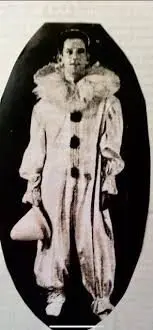
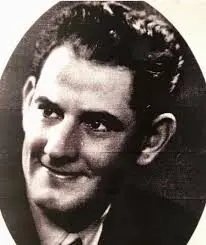
David John Jones (Dai Tenor) was born on 29 June 1906 in Pant-teg in the Swansea Valley, the youngest of the five children (three sons and two daughters) of Daniel and Maria Jones. His father, Daniel Jones, spent the years 1910-20 working in the tinplate industry in Russia, before returning to the post of foreman at the Dyffryn tinplate works in Pontardawe. The family moved to Commercial Road, Rhyd-y-fro, near Pontardawe, and at the age of 14 David was employed at the local tinplate works.
Dai Tenor started singing at the age of Twenty when he was discovered by W,D. Clee at a choir practice in Rhydyfro chapel after Dai was forced out of the Basses section and reluctantly sat with the tenors. Clee recognised Dai’s Tenor range immediately and taught Dai to develop his magnificent voice. After singing in a local eisteddfod he was asked to join the Carl Rosa opera company where his development continued at a faster pace,so much so that he was chosen to be the understudy to the famous Italian tenor Benjamino Gigli.In 1936 while on the journey to Italy to become principal tenor at La Scala Milan Opera Co,Italy’s war with Abyssinia curtailed that venture and Dai made a tour of South Africa instead.From the 1920s to the 1950s Dai sang in every major town or city in England,Scotland, Ireland and Wales. His voice filled the largest Halls without the use of a microphone.His voice was described by the Baritone Bruce Dargavel as having the volume of the Amazon and the clarity of a Welsh mountain stream.His concerts were characterised with Dai displaying his vocal range and his top C note would always motivate the audience into extatic applause including the orchestral members.Dai spent his later years as a park keeper and died in 1978.
And a personal message from Trevor (Dai’s son)
My father was fully aware of his background and during rehearsals would always sing in full voice so that the workers who were preparing the concert or operatic stage would have a free hearing of his voice….most singers usually reserved the full voice for the performance.
A relic of old Pontardawe (very old)
A few years ago a member of the Swansea Valley History Society made an
important and extraordinary find at ‘the bottom of his garden’.
His daughter had bought him a tree as a present and whilst digging the hole to
plant it, he unearthed an unusual stone. As he thought it was something of
importance he took it to the National Museum of Wales in Cardiff.
Unfortunately, due to Covid it took the museum a while to confirm that it was an
axe head and date it. The museum report is shown below on the next page. The
axe has been dated between 4000 to 2350 BC and a full description is given in
the report.
It has recently been returned to our member as the museum does not wish to
retain it. It has been donated
(Editor’s note: As a point of interest the age range of this stone given in the
report corresponds to the dates when Stonehenge was being built. Also, the
report states that the stone is of volcanic origin. Now (and 4000 years ago) there
are no volcanic rocks found naturally in the vicinity of Pontardawe, the nearest in
Wales are found in Pembrokeshire and further away in North Wales. Possibly
this axe head was brought to Pontardawe and traded. Hugh Jones)
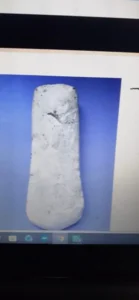
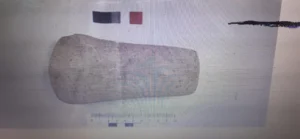
This is a complete polished stone axe of Neolithic date (c. 4000-2350 BC) The axe is
sub-trapezoidal in plan and lenticular / lentoid in section and profile with a narrow
butt that expands to a curved cutting edge (overall length 174.5mm). The butt is
43mm wide with a slightly convex edge and has a narrowed butt with a very slightly
curved edge. Both faces are convex with one face having a slightly higher curve than
the other. The sides expand gradually for 94.5mm down the length (where the width
is 58mm), then flares in width to the curved / rounded cutting edge (70.7Tm wide)
that is slightly asymmetrical in plan, possibly from use. The axe is thickest at the
centre (24.3mm max thickness). The axe has scars and gashes from both historic
and more recent damage, including a deep V- sectioned gash 18.4mm long on one
face towards the but and a chunk of the corner of the cutting edge has been
removed.
A black stain runs transversely across the cutting edge and a patch of the same
black stain marks the centre of the axe about halfway down one face. Cupped /
crescentic scars are seen along the edges from where it has been knapped into
shape. The axe has been polished with scratch / file marks visible across both faces.
The stone is smooth and chalky with a very fine sediment, indicating a tuffaceous
(volcanic) stone. The object is light brownish grey in colour with dark brown
inclusions and orangey veins and weighs 357.45g.
Thanks to Dan Cox Senior Laboratory Officer (Natural Sciences) at Amguedda
Cymru for his help
A broadly similar roughout axe is recorded on the PAS database: WREX 7A9 DE6